Gaudí, Catalan imagination, and the art of seeing differently

What if a house could teach us to see differently?
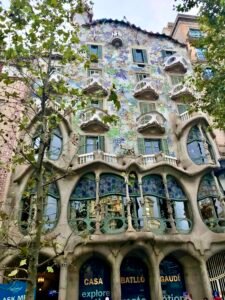
In the heart of Barcelona, along the elegant Passeig de Gràcia, stands a building that seems almost alive.
Its walls curve. Its windows resemble mysterious eyes. Its balconies evoke bones, while its rooftop suggests the scales of a sleeping dragon.
Nothing about Casa Batlló feels ordinary.
And perhaps that’s precisely the point.
Antoni Gaudí created more than an extraordinary building. He imagined a place where nature, architecture, imagination, and cultural identity could come together in ways that continue to surprise us more than a century later.
For our family, Casa Batlló has become one of those places we return to—not simply to admire its beauty, but to rediscover something we can easily lose in the busyness of everyday life.
Our capacity for wonder.
A House That Tells a Story
To understand Casa Batlló, it helps to understand something about Catalonia.
Here, architecture is rarely just about buildings. It can also be an expression of history, imagination, identity, and the stories that communities carry through generations.
Between 1904 and 1906, Gaudí transformed an existing residential building for the Batlló family, creating one of the most imaginative expressions of Catalan Modernisme.
Rather than following conventional architectural rules, he drew inspiration from the natural world.
Look closely and you’ll find suggestions of waves, shells, bones, scales, and flowing water.
Even the light seems to become part of the architecture.
But there’s another story hidden within its remarkable façade.
The Legend of Sant Jordi
Every April 23, Catalonia celebrates Diada de Sant Jordi, a beloved tradition in which people exchange books and roses.
The celebration draws upon the legend of Saint George, the dragon, and the princess—a story deeply woven into Catalan cultural identity.
Many people see references to that legend throughout Casa Batlló.
The colorful rooftop resembles a dragon’s scaled back. The cross-topped turret has been interpreted as the weapon of Sant Jordi. The balconies suggest skulls or masks, while the building’s organic forms evoke the bones of a mythical creature.
Gaudí never left us a definitive explanation confirming every detail of this interpretation.
And perhaps that makes the building even more intriguing.
Rather than telling us exactly what to see, Casa Batlló invites us to imagine.


When Nature Becomes Architecture
One of the things we appreciate most about Gaudí is his extraordinary attention to the natural world.
He seemed to recognize something that modern life often encourages us to overlook: nature is filled with forms, patterns, colors, and relationships that deserve our attention.
At Casa Batlló, straight lines give way to curves.
Walls seem to move like water. Windows open into unexpected shapes. The attic’s white arches resemble the rib cage of an enormous creature.
And throughout the house, light becomes a quiet storyteller.
One of our favorite places is the central lightwell.
Its beautiful blue tiles become progressively darker toward the upper floors, helping balance the appearance of natural light throughout the building.
It’s a remarkable example of Gaudí combining practical design with artistic imagination.
But what stays with us isn’t simply the cleverness of the design.
It’s the experience of standing there.
Watching the light.
Noticing the changing shades of blue.
Realizing how much thought went into something that many visitors might walk past without a second glance.
On one visit, we found ourselves simply sitting there, taking it all in.
Nothing particularly dramatic happened.
And yet, it became one of our favorite memories.
Sometimes wonder doesn’t arrive through a spectacular experience.
Sometimes it begins when we finally pay attention.
Discovering Beauty Through Different Perspectives
Our family has lived in Catalonia for several years, and we’ve come to love its language, traditions, creativity, and people.
But we’ve also discovered that experiencing a place deeply requires more than simply learning its history or visiting its landmarks.
It requires a willingness to see things from another perspective.
That’s something we’ve learned in a particularly meaningful way through our son.
He experiences and engages with the world differently, and over the years, he’s helped us recognize details, possibilities, and moments of beauty that we might otherwise overlook.
As a family, we’ve learned that there isn’t only one way to experience the world.
And that lesson has shaped the way we approach art, culture, and travel.
It’s also one reason Casa Batlló holds a special place in our hearts.
A Place Where Creativity and Inclusion Meet
During our visits, we learned about Casa Batlló’s commitment to employing neurodivergent people, including autistic staff members.
For a family like ours, this was particularly meaningful.
Here was a place celebrated around the world for its extraordinary imagination, also seeking to recognize the abilities and contributions of people who experience the world differently.
It reminded us that creativity isn’t limited to the artist who designs a building.
It can also be found in the different ways people think, perceive, contribute, and connect.
And perhaps that’s another invitation Casa Batlló offers.
To recognize that the world becomes richer when we make room for different perspectives.
A Living Expression of Catalan Creativity
Although Casa Batlló was completed more than a century ago, its story hasn’t stopped unfolding.
The building continues to inspire new interpretations through art, technology, music, and immersive experiences.
One particularly memorable example is Nits Màgiques, the rooftop concert series that brings music into the extraordinary setting of Gaudí’s architecture.
Imagine listening to live music surrounded by sculptural chimneys, with Barcelona stretching out around you.
The dragon-inspired rooftop takes on a different character as daylight fades and the city lights begin to appear.
The building has also served as a canvas for contemporary light and projection artworks, introducing Gaudí’s imagination to new audiences in unexpected ways.
These experiences remind us that culture isn’t something frozen in the past.
It continues to evolve.
New artists reinterpret old stories. Familiar places take on new meanings. Different generations discover their own connections to a shared cultural heritage.
And a house designed more than a hundred years ago continues to spark curiosity.
Experiencing Casa Batlló Beyond the Photograph
Casa Batlló is one of Barcelona’s most recognizable landmarks.
Thousands of visitors come to admire its façade, photograph its unusual balconies, and experience Gaudí’s remarkable architecture.
And understandably so.
But we think there’s something particularly rewarding about approaching this place with a different intention.
Instead of asking how quickly you can see everything, consider what might happen if you gave yourself permission to linger.
Notice the changing light.
Follow the curves of a doorway.
Look at the craftsmanship in a window frame.
Consider how the building connects to Catalan history and the imagination of the people who created it.
And perhaps ask yourself what Gaudí noticed in the natural world that inspired him to create something so extraordinary.
The goal isn’t simply to leave knowing more about Casa Batlló.
It’s to leave seeing a little differently.
A Few Suggestions for Your Visit
If you’re planning to experience Casa Batlló yourself, here are a few things we’ve learned.
Location: Casa Batlló is located at Passeig de Gràcia, 43, in Barcelona’s Eixample district. It’s easily accessible by public transportation and surrounded by other remarkable examples of Modernist architecture.
When to visit: We particularly enjoy visiting when the light is softer, especially in the morning. Booking ahead is advisable, as this is one of Barcelona’s most popular attractions.
Take your time: Allow yourself enough time to appreciate the architectural details rather than simply moving from room to room.
Explore the experiences: Casa Batlló offers different ticket options and immersive experiences. Check its official website for current availability, prices, and seasonal programming, including rooftop events.
Discover the surrounding neighborhood: After your visit, spend some time exploring Passeig de Gràcia and the surrounding Eixample streets. You’ll encounter more Modernist architecture, local cafés, and opportunities to experience everyday Barcelona beyond its famous landmarks.
And one final suggestion:
Don’t feel that you need to understand every architectural detail to appreciate the experience.
Sometimes curiosity is enough.
An Invitation to Recapture Wonder
We often think of wonder as something belonging to childhood.
Children seem naturally capable of being amazed by things adults have learned to take for granted.
A strange shape.
An unexpected color.
The way sunlight moves across a wall.
But perhaps wonder isn’t something we inevitably lose as we grow older.
Perhaps it’s something we can learn to recover.
Places like Casa Batlló remind us that the world still holds extraordinary beauty, imagination, and mystery.
Sometimes we simply need to look closer.
For our family, this remarkable house has become more than a Barcelona landmark.
It’s a reminder that creativity can challenge our expectations, that different perspectives enrich our experience, and that the places we encounter can change the way we see the world.
And that, for us, is what it means to go beyond.