History, everyday encounters, and the stories unfolding around one of Barcelona’s most familiar landmarks.
What if the most interesting thing about a monument isn’t the monument itself?
Walk toward Barcelona’s Arc de Triomf on almost any pleasant afternoon, and you’ll find people taking photographs of its distinctive red-brick arches.
It’s easy to understand why.
The monument stands proudly at the entrance to Passeig de Lluís Companys, one of the city’s most inviting promenades. Its elegant proportions, decorative sculptures, and warm brickwork make it a natural stopping point for visitors exploring Barcelona.
But spend a little more time here, and something interesting begins to happen.
You start noticing the people.
Children chasing pigeons. Friends meeting beneath the arch. Musicians filling the promenade with sound. Skateboarders practicing their latest tricks. Families enjoying an afternoon together.
The monument remains impressive, but gradually, the life unfolding around it becomes just as fascinating.
And that’s what we love about this corner of Barcelona.
It’s a place where history and everyday life meet.
An Arch with a Different Story
When we think of triumphal arches, we often imagine monuments celebrating military victories.
Barcelona’s Arc de Triomf tells a different story.
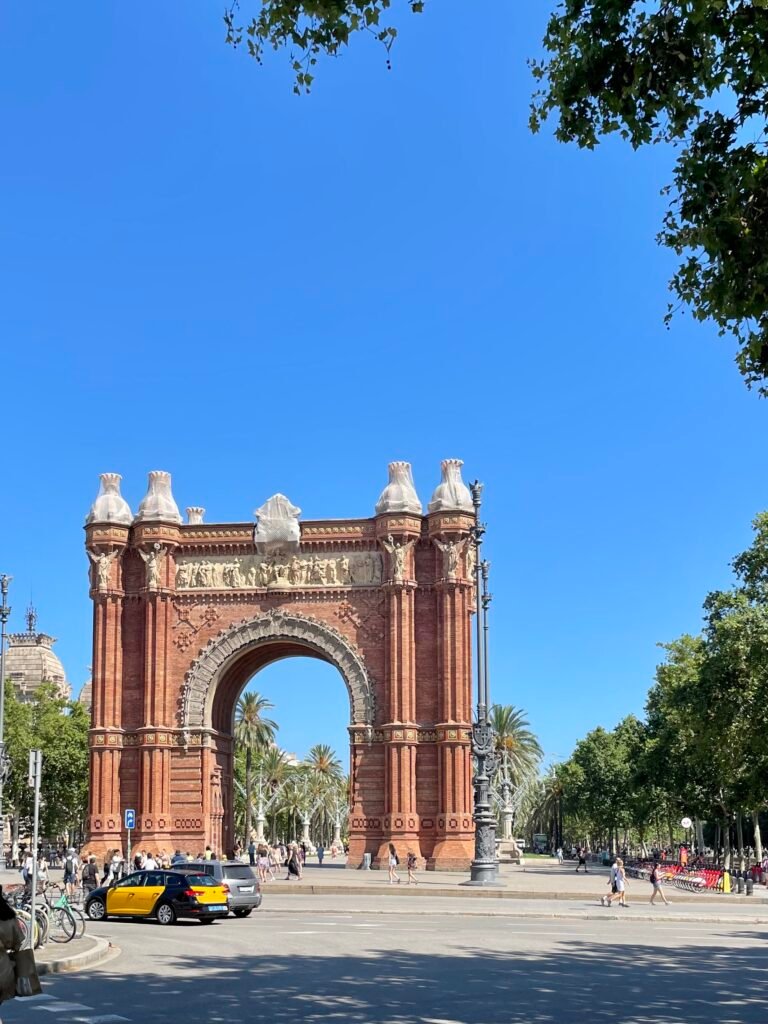
Designed by architect Josep Vilaseca i Casanovas and completed in 1888, the arch served as the principal entrance to the Barcelona Universal Exposition.
The exhibition represented an important moment in Barcelona’s transformation into a modern European city.
During the nineteenth century, Barcelona was experiencing extraordinary changes. Industrialization, urban expansion, and new artistic movements were reshaping its identity.
The Universal Exposition offered an opportunity to present the city’s achievements and ambitions to the wider world.
And the Arc de Triomf became its welcoming gateway.
Rather than celebrating conquest, its decorative program emphasized ideas such as progress, artistic achievement, and hospitality.
One of the principal sculptural reliefs, created by Josep Reynés, represents Barcelona welcoming the nations.
That detail is particularly meaningful.
Here stands a triumphal arch whose story is not primarily about defeating others, but about opening a city to the world.
It’s a fascinating expression of the Barcelona that was emerging at the end of the nineteenth century.
And perhaps it offers an invitation that remains relevant today.
What does it mean for a city to welcome the world while remaining rooted in its own identity?
A Monument Rooted in Catalan Identity
Take a closer look at the arch, and you’ll discover that its architectural details communicate something about the cultural identity of Barcelona.
Unlike the pale stone of many European triumphal arches, Barcelona’s monument is constructed primarily from red brick.
Its design incorporates elements associated with Neo-Mudéjar architecture, along with decorative references to the artistic traditions of the region.
You’ll also notice sculptural reliefs and symbolic imagery celebrating the arts, commerce, agriculture, and industry.
These weren’t simply decorative choices.
They reflected the aspirations of a city eager to demonstrate its creativity, economic vitality, and cultural significance.
Today, the Arc de Triomf stands as a reminder of a particular moment in Barcelona’s history.
But the story doesn’t end in 1888.
Because cities aren’t museums.
They’re living places, continually shaped by the people who inhabit them.
And nowhere is that more evident than on the promenade stretching beyond the arch.
The Life Between the Landmarks
One of our favorite things about Passeig de Lluís Companys is that you don’t really need a plan.
You can simply arrive.
Find a bench.
Watch.
Listen.
And allow the city to reveal itself.
The wide, palm-lined promenade connects the Arc de Triomf with Parc de la Ciutadella.
On any given afternoon, you might encounter street musicians, families, cyclists, people walking their dogs, and groups of friends enjoying the open space.
Sometimes you’ll hear Catalan.
Other times, Spanish, English, or any number of languages spoken by the people who now call Barcelona home—or who have come to discover it.
It’s a reminder that a city’s identity is never expressed through architecture alone.
It’s also found in its rhythms, relationships, conversations, and shared public spaces.
For our family, this is one of the things we’ve come to appreciate most about living in Catalonia.
We’ve discovered that understanding a place requires more than knowing its history.
It also means paying attention to how people experience it today.
And sometimes, the most interesting cultural discoveries happen when nothing particularly extraordinary is taking place.
A conversation between neighbors.
A musician drawing a small crowd.
A child learning to ride a bicycle.
Everyday moments that might never appear in a travel guide but nevertheless reveal something about the character of a place.
Our Favorite Time to Be Here
We particularly enjoy this part of Barcelona in the late afternoon during autumn.
There’s something beautiful about the way the sunlight filters through the trees and casts a warm glow across the promenade.
The brick of the arch seems to deepen in color.
People begin gathering after work or school.
And the atmosphere gradually shifts from the movement of the day toward the more relaxed rhythm of the evening.
We’ve spent time sitting along the promenade, simply watching the city unfold around us.
No tickets.
No itinerary.
No particular destination.
Just the pleasure of being present.
It’s the kind of experience that reminds us why we fell in love with exploring Catalonia in the first place.
Not because every moment needs to be extraordinary.
But because ordinary moments often have more to offer than we expect.
Beyond the Arch: A Neighborhood Full of Stories
One of the wonderful things about Arc de Triomf is its location.
From here, you can explore several different expressions of Barcelona’s history and culture, all within a relatively short walk.
And each offers a different perspective on the city.
Parc de la Ciutadella: From Fortress to Public Space
Continue along Passeig de Lluís Companys, and you’ll arrive at Parc de la Ciutadella.
Today, it’s one of Barcelona’s most beloved green spaces.
Families gather beneath the trees. Friends share picnics. Musicians practice. Visitors wander through the gardens or admire the monumental fountain known as the Cascada.
But this peaceful setting carries a complicated history.
Following the defeat of Barcelona in 1714 during the War of the Spanish Succession, a large military citadel was constructed here under Philip V.
The fortress became a symbol of Bourbon military control over the city.
During the nineteenth century, much of the citadel was demolished, and the area was transformed into a public park.
The park later became the principal site of the 1888 Universal Exposition.
That transformation is remarkable.
A place once associated with military domination eventually became a gathering place for public life, recreation, and cultural exchange.
Knowing this history changes the way we experience the park.
What initially appears to be simply a beautiful green space becomes part of a much larger story about Barcelona’s past.
El Born: Where History Remains Visible
A short walk from the arch brings you into El Born, one of Barcelona’s most atmospheric neighborhoods.
Its narrow streets, historic buildings, small shops, and creative spaces invite exploration.
But beneath the neighborhood’s contemporary energy lies a complex history.
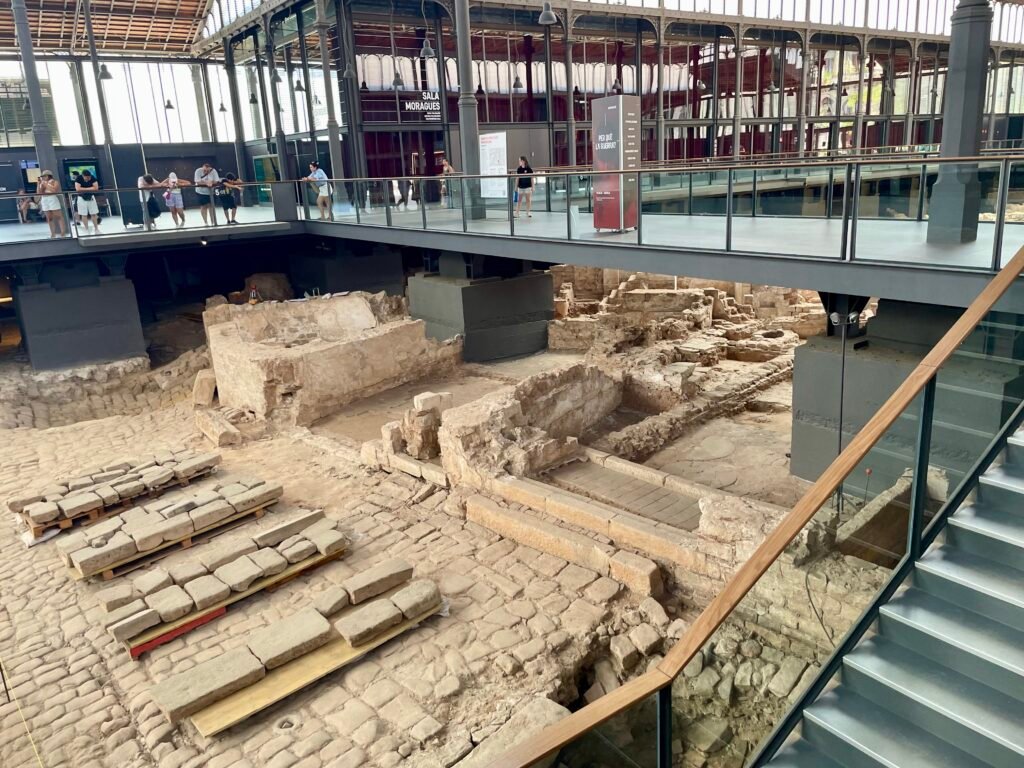
At El Born Centre de Cultura i Memòria, visitors can encounter archaeological remains of streets and buildings associated with the neighborhood that existed before the eighteenth-century destruction connected to the construction of the citadel.
It’s an extraordinary opportunity to see how historical events affected the everyday lives of people who once inhabited this part of Barcelona.
History suddenly becomes more personal.
We’re no longer thinking only about kings, armies, or political events.
We’re thinking about homes.
Shops.
Families.
And communities whose lives were profoundly changed.
For us, these are the kinds of cultural encounters that make exploring Barcelona so rewarding.
They remind us that every neighborhood holds stories worth remembering.
Mercat de Santa Caterina: Culture Around the Table
Another nearby favorite is Mercat de Santa Caterina.
Its colorful, undulating roof is a striking example of contemporary architecture, but the market’s real attraction is found beneath it.
Fresh produce.
Seafood.
Cheeses.
Olives.
The conversations between vendors and customers.
Markets offer a particularly meaningful way to experience local culture because food is never just about eating.
It’s connected to traditions, family memories, regional identity, and the rhythms of everyday life.
Spend some time exploring the stalls, and you’ll encounter ingredients and culinary traditions that help tell the story of Catalonia.
And perhaps you’ll discover something new to bring to your own table.
The Art of Exploring Without Rushing
We often approach travel with a list of places we need to see.
And Barcelona certainly offers enough extraordinary landmarks to fill several itineraries.
But we’ve found that some of our most meaningful experiences happen when we leave room for the unexpected.
Arc de Triomf is a wonderful place to practice that kind of exploration.
You might begin by admiring the monument.
Then find yourself listening to a street musician.
Or following a conversation into a nearby café.
Or wandering toward Parc de la Ciutadella without knowing exactly where the afternoon will lead.
None of these experiences requires a carefully organized itinerary.
They simply require time and curiosity.
And perhaps a willingness to recognize that the people and places we encounter have something to teach us.
That’s one of the ideas at the heart of BCN & Beyond.
To go beyond isn’t always to travel farther. Sometimes it’s to discover more deeply what’s already in front of us.
A Few Suggestions for Your Visit
If you’re planning to explore this part of Barcelona, here are a few practical suggestions.
Getting there: Arc de Triomf has its own Metro station on Line 1 and is also served by Rodalies commuter trains. It’s within walking distance of the Gothic Quarter, El Born, and central Barcelona.
When to visit: Morning offers a quieter atmosphere and beautiful light for photography. Late afternoon is particularly enjoyable if you’d like to experience the promenade as people gather and the neighborhood comes alive.
Take a walk: Follow Passeig de Lluís Companys toward Parc de la Ciutadella. Allow yourself time to stop, observe, and enjoy the atmosphere.
Explore the neighborhood: Wander into El Born, visit Mercat de Santa Caterina, or discover the exhibitions at El Born Centre de Cultura i Memòria.
Experience local food: Consider enjoying a vermut with a few small plates, discovering a neighborhood café, or putting together a simple picnic with fresh bread, cheese, and fruit from a local market.
Cost: Visiting the arch and walking along the promenade are free. Some nearby museums and cultural attractions may charge admission.
And one final suggestion:
Don’t treat the arch as merely a place to stop on your way somewhere else.
Give yourself permission to stay a while.
There’s Always More to the Story
When we first encounter a monument like Arc de Triomf, it’s natural to focus on what we can see.
Its architecture.
Its history.
Its beauty.
But the longer we spend in a place, the more we begin to recognize that its story extends far beyond the monument itself.
It lives in the people who gather there.
The languages spoken along the promenade.
The memories carried by nearby neighborhoods.
And the ordinary moments that make a city feel alive.
Perhaps that’s what we love most about Arc de Triomf.
It reminds us that cultural discovery doesn’t always require an extraordinary destination.
Sometimes it begins with a familiar landmark, an unhurried afternoon, and a willingness to pay attention.
And sometimes, the most meaningful part of a journey isn’t what we came to see.
It’s what we discover when we look beyond it.